

Legal AI adoption is accelerating across the legal industry — but many firms still struggle to assess how operationally mature their AI capabilities actually are. While some organizations remain stuck in isolated pilot phases, others are embedding AI into workflows, governance structures, pricing models, and scalable client delivery environments.
This article introduces a structured five-stage Legal AI Maturity Map designed to help firms evaluate their current position, identify operational and governance gaps, and plan sustainable transformation strategies.
Covering governance, workflow integration, organizational readiness, delivery models, and operational scalability, the framework argues that successful Legal AI adoption is not primarily a technology challenge — but an institutional capability challenge centered around governance, operational integration, and scalable legal infrastructure.
AI won’t transform legal services sustainably unless firms operationalize adoption systematically.
Legal AI is no longer a futuristic concept. It is already reshaping contract analysis, due diligence, legal research, compliance workflows, document automation, knowledge management, and client interaction.
Yet many firms still struggle to evaluate where they actually stand.
Are they experimenting with isolated tools?
Are they embedding AI into operational workflows?
Or are they redesigning the legal operating model itself?
The Legal AI Maturity Map is designed as a structured self-assessment framework for evaluating AI capability, operational integration, governance readiness, and transformation maturity.
The framework intentionally avoids treating AI adoption as a purely technical issue. Sustainable adoption depends on governance structures, workflow integration, organizational alignment, operational observability, legal accountability, and institutional learning capacity.
The 5 Stages of Legal AI Maturity
| Stage | Organizational State | Operational Characteristics | Assessment Questions | Governance & Delivery Maturity | Transformation Potential | Typical Organizational Profile |
|---|---|---|---|---|---|---|
| 1 – Awareness | AI is recognized as strategically relevant, but adoption remains largely observational and externally driven. | Trend monitoring, conference exposure, isolated curiosity, no operational ownership, no workflow integration. | – Are AI topics discussed at leadership level? – Is anyone tracking market developments? – Have initial risks and opportunities been identified? – Are clients beginning to ask about AI capabilities? → If 2–3 answers are Yes → Stage 1 reached. | Minimal governance maturity. AI remains disconnected from operational delivery. | Strategic awareness only. | Traditional partnership-driven firms, documentation-centric legal environments, highly risk-averse organizational cultures. |
| 2 – Experimentation | Initial pilots and controlled experiments emerge across selected teams or innovation-oriented units. | Proof-of-concepts, isolated workflow testing, vendor evaluations, exploratory use-case validation. | – Have pilots been formally initiated? – Are teams testing AI collaboratively? – Are evaluation criteria documented? – Have governance concerns been identified? → If 3+ answers are Yes → Stage 2 reached. | Emerging governance discussions. Operational consistency remains fragmented. | Localized productivity gains and early workflow acceleration. | Innovation-oriented practice groups, digitally curious mid-sized firms, isolated transformation initiatives within larger organizations. |
| 3 – Operational Use | AI becomes embedded into selected legal workflows and client delivery processes. | Workflow integration, operational usage, measurable efficiency improvements, emerging process standardization. | – Are AI tools integrated into daily work? – Are clients receiving AI-supported outputs? – Are responsibilities formally defined? – Are operational KPIs monitored? → If 3+ answers are Yes → Stage 3 reached. | Defined governance structures. Operational oversight and accountability mechanisms begin to stabilize. | Significant workflow acceleration and scalable delivery optimization. | Operationally maturing business law firms, process-oriented legal units, digitally coordinated delivery environments. |
| 4 – Integrated Practice | AI becomes part of a coordinated legal operating environment across workflows, teams, and delivery models. | Cross-functional orchestration, legal engineering capabilities, structured enablement programs, scalable operational integration. | – Are multiple workflows AI-enabled? – Are legal engineers or AI specialists involved? – Is AI integrated into delivery standards? – Is structured training institutionalized? → If 3+ answers are Yes → Stage 4 reached. | Mature governance structures with coordinated operational oversight and integrated delivery standards. | Scalable legal service delivery and operational transformation. | Technology-enabled firms with legal operations functions, legal engineering capabilities, and coordinated transformation governance. |
| 5 – Strategic Enablement | AI becomes embedded into institutional strategy, governance architecture, pricing logic, and platform-oriented service models. | AI-native operating models, embedded governance systems, continuously optimized legal infrastructure, platform integration capabilities. | – Are AI-enabled services strategically developed? – Does AI influence pricing or delivery models? – Is AI integrated into enterprise governance? – Are operational capabilities continuously optimized? → If 3+ answers are Yes → Stage 5 reached. | AI evolves from isolated tooling into strategic operational infrastructure and institutional capability. | Structural transformation of legal service delivery and business architecture. | Platform-oriented legal organizations with integrated governance environments, scalable delivery infrastructure, and operational AI coordination layers. |
Please note: The organizational profiles above are indicative abstractions rather than rigid classifications. Individual practice groups, innovation units, or regional entities may operate at significantly different maturity levels within the same organization.
Beyond Tool Adoption
Many firms evaluate AI maturity primarily through tooling.
But sustainable transformation depends less on which model is deployed — and more on whether firms can operationalize governance, workflows, accountability, knowledge management, and organizational learning around AI-enabled systems.
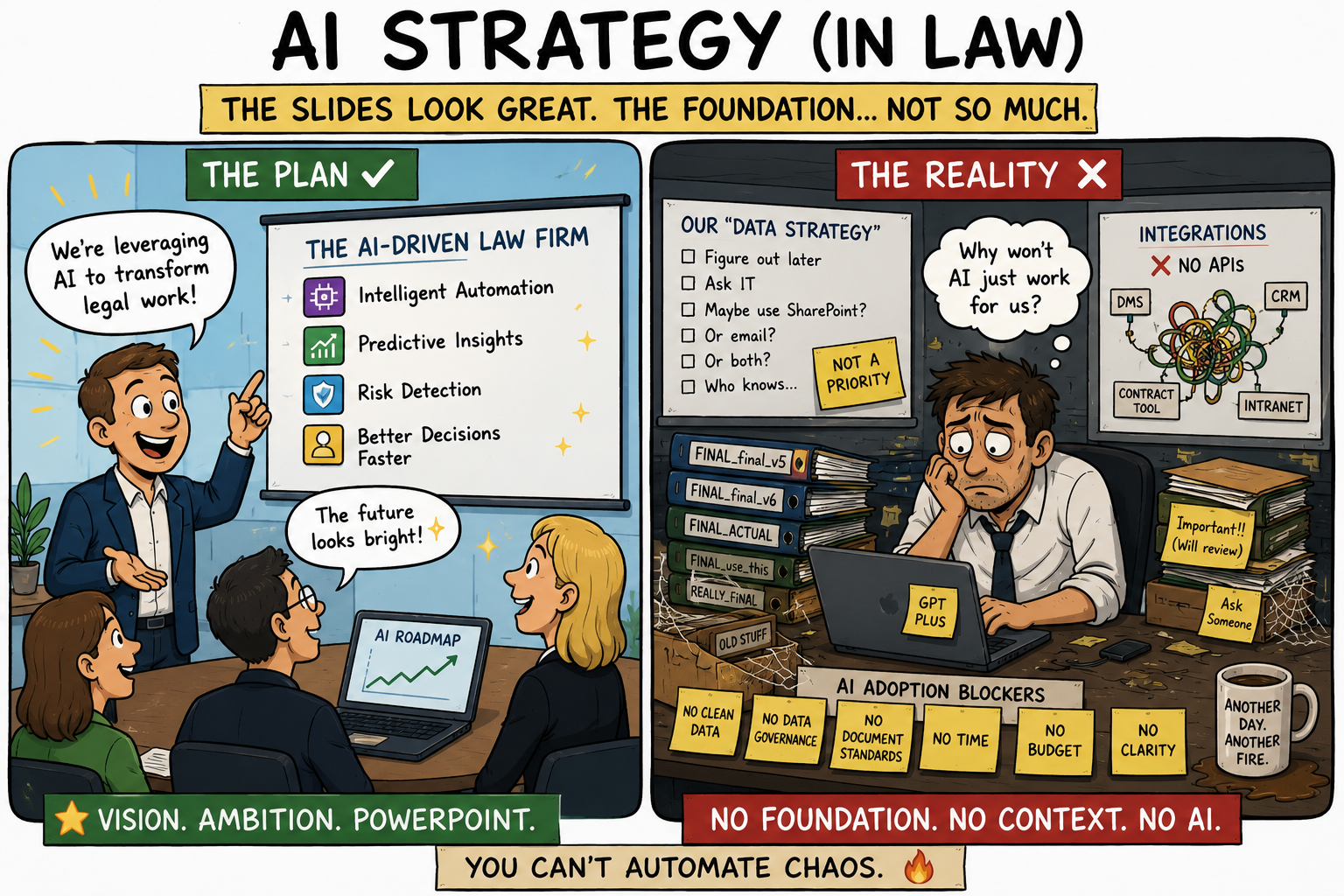
In practice, many organizations overestimate maturity because experimentation is mistaken for transformation.
Running pilots does not necessarily create operational capability.
True maturity emerges when AI becomes:
- integrated into delivery workflows
- governed through operational controls
- observable and auditable
- aligned with organizational accountability
- embedded into scalable operating models
The Structural Shift Behind Legal AI Adoption
The long-term impact of AI in law may not primarily come from isolated productivity gains.
It may emerge from a broader transformation of how legal services are operationalized, coordinated, delivered, and scaled.
As firms move toward higher maturity stages, they increasingly evolve from document-centric advisory organizations toward integrated legal operating environments.
This transformation affects:
- workflow architecture
- governance structures
- knowledge systems
- staffing models
- pricing structures
- client interaction models
- operational observability
- platform integration capabilities
AI maturity therefore becomes less a technology issue — and more a question of institutional operating capability.
Why This Framework Matters
- It creates strategic clarity beyond AI hype.
- It identifies operational blind spots and governance gaps.
- It aligns leadership, operations, and legal teams around shared maturity criteria.
- It supports sustainable investment decisions.
- It reframes AI adoption as organizational transformation rather than isolated tooling.
AI maturity is not defined by experimentation alone — but by whether firms can operationalize trust, governance, workflows, and scalable delivery.
Conclusion
Legal AI adoption is not a binary state. It is a maturity journey.
Some organizations will remain trapped in fragmented experimentation. Others will gradually build operational capabilities that reshape how legal services are delivered, governed, and integrated into client environments.
The firms that succeed may ultimately not be those with access to the most advanced models.
They may be the firms capable of building the most resilient legal operating systems around them.
The future of legal AI may depend less on who experiments first — and more on who operationalizes adoption sustainably.
- Susskind, R. (2023). Tomorrow’s Lawyers: An Introduction to Your Future. 3rd ed., Oxford University Press. URL: https://global.oup.com/academic/product/tomorrows-lawyers-9780192864727
- Warren, Z., Abbott, M., Leach, L., Seemer, S., Seymour, M., Taylor, T., & Wirth, G. (Thomson Reuters Institute) (2025). 2025 Generative AI in Professional Services Report. Thomson Reuters. URL: https://www.thomsonreuters.com/en/reports/2025-generative-ai-in-professional-services-report
- Biermann, P., Petersen, T., Schneider, A.-L., Wenzler, H., & Schroer, P. (Bucerius Center on the Legal Profession & Simon-Kucher) (2025). The AI-Conomics of Legal Services. URL (PDF): https://www.law-school.de/fileadmin/content/law-school.de/de/units/abt_education/Studienseite/Studien/Bucerius_CLP_AI-Conomics_Studie_2025.pdf
- Wolters Kluwer. (2026). Future Ready Lawyer Survey Report 2026: Building Confidence in an AI Era. URL: https://www.wolterskluwer.com/en/know/future-ready-lawyer-2026
- Association of Corporate Counsel. (2024). ACC Legal Operations Maturity Model. URL: https://www.acc.com/sites/default/files/program-materials/upload/Legal-Opertaitons-Maturity-Model-2.0---ACC.pdf
- Corporate Legal Operations Consortium (CLOC). Core 12 Maturity Assessment Playbook. URL: https://cloc.org/core-12-maturity-assessment-playbook/
- Corporate Legal Operations Consortium (CLOC). CLOC Core 12. URL: https://cloc.org/cloc-core-12/
- SimpleLegal. (2020). The Legal Ops Maturity Model by SimpleLegal. URL (PDF): https://cloc.org/wp-content/uploads/2024/12/The-Legal-Ops-Maturity-Model-by-SimpleLegal_Nov2020.pdf
- Giannakis, M., Doran, D., Mee, D., Papadopoulos, T., & Dubey, R. (2018). The Design and Delivery of Modular Legal Services: Implications for Supply Chain Strategy. International Journal of Production Research, 56(20), 6607–6627. URL: https://www.tandfonline.com/doi/full/10.1080/00207543.2018.1449976
- Hartung, D., & Gerlach, L. / Legal Tech Verband Deutschland. (2025). Legal Tech Monitor 2025: The Market for Digitalization of Legal Services in Germany. URL (PDF): https://legaltechverband.de/wp-content/uploads/2025/03/Legal-Tech-Monitor-2025_EN.pdf
- Microsoft Corporation. (2025). 2025: The Year the Frontier Firm Is Born. Microsoft Work Trend Index Annual Report. URL: https://www.microsoft.com/en-us/worklab/work-trend-index/2025-the-year-the-frontier-firm-is-born
- McKinsey & Company. (2025). The State of AI in 2025: Agents, Innovation, and Transformation. McKinsey Global Survey. URL: https://www.mckinsey.com/capabilities/quantumblack/our-insights/the-state-of-ai
- Katz, D. M. (2014). The MIT School of Law? A Perspective on Legal Education in the 21st Century. University of Illinois Law Review, 2014(5), 1431–1472. URL: https://illinoislawreview.org/print/vol-2014-no-5/the-mit-school-of-law-a-perspective-on-legal-education-in-the-21st-century/