
Modern organizations increasingly operate through APIs, cloud infrastructure, AI systems, automated workflows, and continuously changing data environments. Yet many compliance models still rely on static documentation, periodic audits, and retrospective controls.
This article explores the shift toward Compliance by Code — an operational approach in which governance becomes embedded directly into digital systems through executable rules, monitoring layers, audit trails, and continuous validation mechanisms.
It examines how compliance is evolving from a document-centric reporting function into observable infrastructure capable of enforcing policies in real time. At the same time, the article highlights the risks of opaque governance logic, automated enforcement, and infrastructure dependency as compliance increasingly moves into the runtime layer of modern organizations.
Compliance is no longer only something organizations document after the fact. In digital systems, governance either operates continuously — or fails continuously.
For decades, compliance has largely been treated as a documentation problem — policies, checklists, audits, reports, and periodic reviews.
But in increasingly digital organizations, that model no longer scales.
Modern companies operate continuously across APIs, cloud infrastructure, AI systems, data platforms, and automated workflows. Governance can no longer rely only on static controls and retrospective audits. It must become operational, observable, and continuously verifiable.
This is the shift toward Compliance by Code.
From Static Controls to Continuous Governance
Traditional compliance often happens after the fact. A process is reviewed, a report is created, a risk is documented, and a control is tested periodically.
But digital systems do not operate periodically. They operate in real time.
Every access request, transaction, model output, data transfer, approval, and system change can create legal or regulatory consequences. Compliance therefore needs to move closer to the systems where those consequences actually occur.
In a Compliance by Code model, governance is embedded directly into operational environments:
- Policies become executable controls
- Obligations become system rules
- Risk thresholds become automated alerts
- Audit trails become continuous evidence
- Compliance becomes part of the runtime
The New Compliance Architecture
Compliance by Code does not mean replacing legal judgment with software. It means translating defined rules, controls, and responsibilities into systems that can monitor, validate, and document compliance continuously.
A modern compliance architecture may include:
- Policy engines: Systems that translate governance requirements into enforceable rules
- Access controls: Permission layers that restrict who can access data, systems, or decisions
- Monitoring APIs: Interfaces that track transactions, events, and control performance
- Audit logs: Continuous records of actions, approvals, changes, and exceptions
- Evidence systems: Structured data that proves compliance without relying only on manual reports
The goal is not automation for its own sake. The goal is traceability, accountability, and operational resilience.
Why This Matters
As organizations become more software-driven, compliance risks increasingly emerge inside systems rather than only inside documents.
A privacy policy is only meaningful if access rights, deletion workflows, consent records, and data transfers actually reflect it. An AI governance framework is only credible if model usage, human oversight, risk classification, and auditability are embedded into the systems where AI is deployed.
Compliance by Code closes the gap between what an organization says and what its systems actually do.
In this model:
- Compliance becomes testable, not merely declarative
- Governance becomes observable, not merely documented
- Controls become continuous, not merely periodic
- Accountability becomes traceable, not merely assigned
Real-World Applications
- Data protection: Consent management, deletion requests, access controls, and data retention rules can be monitored and enforced through digital workflows.
- Financial compliance: KYC checks, transaction monitoring, sanctions screening, and suspicious activity alerts can be integrated directly into operational systems.
- AI governance: Model inventories, risk classifications, human review processes, and audit logs can become part of the AI deployment lifecycle.
- Cloud governance: Security policies, access permissions, data residency rules, and infrastructure changes can be validated continuously.
In practice, this might mean a data transfer being blocked because residency rules are violated, an AI model deployment being halted because no human reviewer has been assigned, or a privileged access request being denied because policy conditions changed in real time.
These are not merely technical safeguards. They are governance decisions expressed through operational systems.
From Audits to Observability
The future of compliance will not be defined only by better reports. It will be defined by better observability.
Organizations need to know not only whether a policy exists, but whether it is working in practice. They need visibility into who did what, when, under which authority, based on which rule, and with what consequence.
This creates a new compliance mindset:
- Logs become legal evidence
- Events become compliance signals
- Exceptions become governance triggers
- Dashboards become accountability interfaces
In digital organizations, you cannot govern what you cannot observe.
The Risks of Compliance by Code
But embedding compliance into code also creates new risks.
If governance logic is hidden inside opaque systems, compliance can become harder to challenge, audit, or understand. Poorly designed rules may be enforced automatically. Biases may become infrastructure. Exceptions may disappear into workflows. Accountability may be shifted from people to systems.
This raises critical questions:
- Transparency: Can legal and compliance teams understand the rules embedded in systems?
- Explainability: Can affected users understand why a decision was made?
- Accountability: Who is responsible when automated controls fail?
- Governance: Who has the authority to change the rules inside the system?
“The future of compliance is not more documentation. It is continuous verification.”
Conclusion
Compliance by Code is not about turning every legal rule into software. It is about making governance operational in the environments where modern organizations actually function.
As legal, technical, and business systems become increasingly interconnected, compliance must move from static documentation to continuous validation.
The organizations that succeed will be those that treat compliance not as a reporting burden, but as trusted infrastructure.
Because in digital systems, governance does not happen once a year. It happens at runtime.
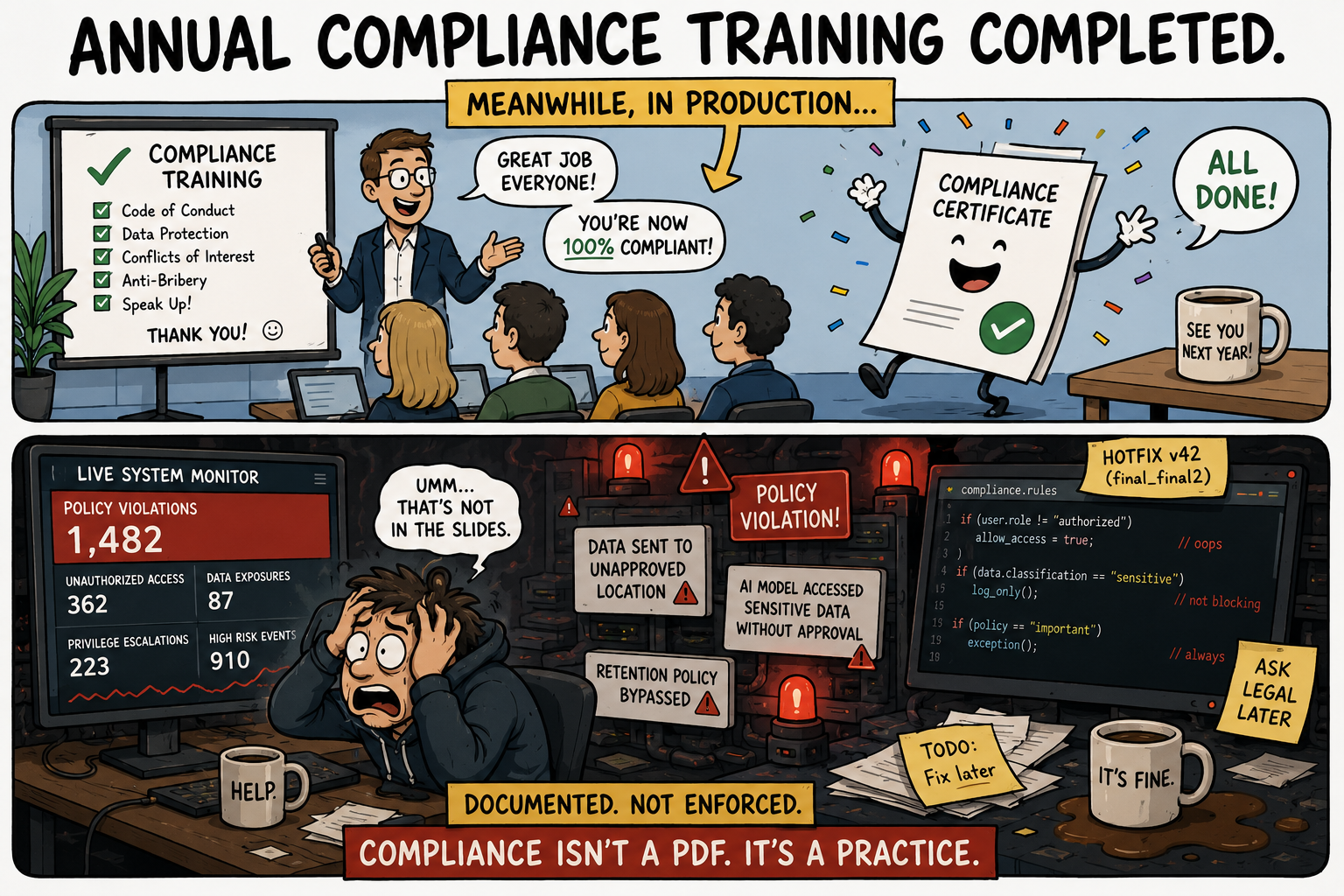
If governance exists only in PDFs while systems behave differently in production, compliance becomes theater.
- Chankramath, A., & Oliver, B. (2026). Policy as code: The platform engineer’s guide to automated governance and compliance. Platform Engineering Advisory & Consulting / Thoughtworks. URL: https://platformengineering.org/blog/policy-as-code
- Henshall, R. (2024). A look into Policy as Code: why now and how can it help? Red Hat Blog. URL: https://www.redhat.com/en/blog/look-policy-code-why-now-and-how-can-it-help
- Gaikwad, C. (2026). What is Policy as Code? Harness DevOps Academy. URL: https://www.harness.io/harness-devops-academy/what-is-policy-as-code
- Wiz Experts Team. (2026). Compliance as Code Explained: Benefits and Implementation. Wiz Academy. URL: https://www.wiz.io/academy/compliance/compliance-as-code
- Kanjilal, J. (2023). Declarative Compliance With Policy-as-Code and GitOps. DevOps.com. URL: https://devops.com/declarative-compliance-with-policy-as-code-and-gitops/
- Trend Micro. (2023). Policy as Code vs Compliance as Code. URL: https://www.trendmicro.com/de_de/research/23/c/policy-as-code-vs-compliance-as-code.html
- Rakuten India. (2025). The Future of Data Governance: Policies and Compliance Essentials. Rakuten SixthSense. URL: https://sixthsense.rakuten.com/blog/The-Future-of-Data-Governance-Policies-and-Compliance-Essentials
- Kuang, D., Hou, L., & Zhao, S. (2026). Policy-as-Code: Flexible Kubernetes Governance with Kyverno. CNCF Blog. URL: https://www.cncf.io/blog/2026/03/19/policy-as-code-flexible-kubernetes-governance-with-kyverno/
- Ruohonen, J., Tuli, E. A., & Morita, H. (2026). Compliance as Code: A Study of Linux Distributions and Beyond. arXiv preprint arXiv:2603.01520. URL: https://doi.org/10.48550/arXiv.2603.01520
- Bandara, E., Gunaratna, A., Gore, R., Rahman, A., Mukkamala, R., Shetty, S., Rajapakse, S., Kularathna, I., Foytik, P., Bouk, S. H., Liang, X., Hass, A., Wee Keong, N., & De Zoysa, K. (2026). AI Trust OS -- A Continuous Governance Framework for Autonomous AI Observability and Zero-Trust Compliance in Enterprise Environments. arXiv preprint arXiv:2604.04749. URL: https://doi.org/10.48550/arXiv.2604.04749
- Dhandala, N. (2026). How to Implement Compliance as Code for Azure Using Terraform Sentinel Policies. OneUptime Blog. URL: https://oneuptime.com/blog/post/2026-02-16-how-to-implement-compliance-as-code-for-azure-using-terraform-sentinel-policies/view