

As AI and automation accelerate into 2026, the central challenge facing organizations is no longer technical capability but the preservation of human responsibility. This article argues that the most consequential risk of AI is not job displacement or machine error, but the subtle redesign of accountability as an optional feature of modern systems. Through defaults, recommendations, and automated workflows, responsibility is increasingly diffused rather than removed—until decisions are made without clear ownership.
The article shows how values such as judgment, critical thinking, and accountability do not disappear because AI replaces them, but because systems are designed in ways that no longer require them. Optional human oversight, automation bias, and performance metrics optimized for speed and measurability gradually erode decision ownership. What cannot be quantified—context, interpretation, long-term judgment—loses visibility, recognition, and economic value.
Rather than opposing AI, the article calls for intentional system design that makes human agency explicit and non-negotiable at critical points. Preserving responsibility requires clear decision rights, mandatory human review thresholds, contestability, and metrics that value decision quality over velocity. The conclusion is clear: AI will continue to advance, but whether responsibility remains central—or quietly becomes optional—is a design choice organizations make with every system they build.
AI won’t erase responsibility. But it can make it optional — and that’s where the real cost begins.
At the beginning of a new year, organizations tend to ask familiar questions: What should we build next? What should we scale? What should we automate?
Less often do we ask the more uncomfortable one: what should we deliberately preserve?
AI is accelerating fast. Not because machines are suddenly capable of everything, but because many decisions about judgment, accountability, and decision ownership are quietly being redesigned in its shadow.
What follows is not an argument against AI or automation. It is an argument against something more consequential: the quiet redesign of responsibility as optional.
What We Choose to Bury
Progress rarely announces what it leaves behind.
When organizations talk about innovation, they usually describe what is gained: speed, efficiency, scale. What disappears in the process often looks insignificant at first — a manual review step, a second opinion, a moment of hesitation.
Over time, these absences accumulate.
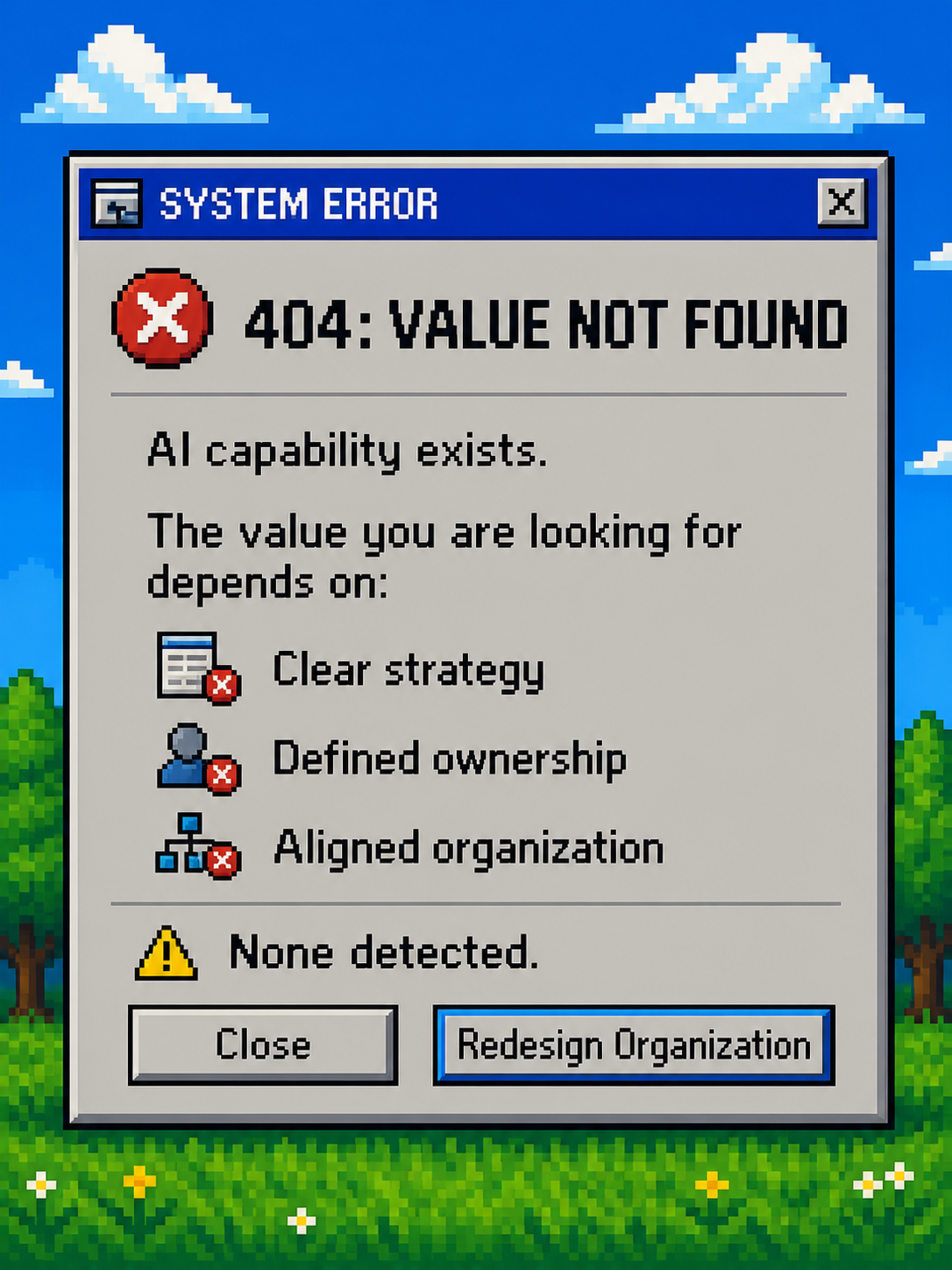
Values like critical thinking, truth-seeking, autonomy, and accountability do not vanish because AI replaces them. They fade when systems are designed in ways that no longer require them.
Once these values stop being operationally necessary, they risk becoming cultural artifacts — admired in retrospectives, referenced in mission statements, but absent from day-to-day decisions.
After the Update
Most responsibility is not removed by decree. It is removed by defaults.
System updates introduce new “recommended” actions. Dashboards prioritize certain metrics. Automated approvals reduce friction. None of these changes appear controversial in isolation.
Yet together, they reshape how decisions are made: what is questioned, what is assumed, and who is expected to own the outcome.
Safety research has long described how failures in complex systems often emerge not from a single catastrophic mistake, but from latent conditions embedded over time — assumptions that remain invisible until a breakdown occurs (Reason, 1990).
In AI-enabled environments, one such latent condition is the quiet erosion of decision ownership. When outcomes are produced by opaque systems, responsibility tends to diffuse. Everyone participates — but no one decides.
Example Case – The “Recommended” Decision That Nobody Owns
A company introduces an AI-assisted workflow that produces a “recommended action” for customer onboarding: approve, reject, or escalate. Human review is still possible — but explicitly framed as optional.
In the interface, approving the recommendation is a single click. Overriding it requires written justification, managerial sign-off, and introduces visible delays. Under time pressure, teams learn which path keeps dashboards green.
Months later, problematic decisions surface. Some legitimate customers were rejected; others were approved despite clear warning signs. When responsibility is questioned, the audit trail fragments: the system recommended, an employee clicked, the process completed.
No rule was violated. No human was removed. Responsibility was simply redesigned as optional — and then optimized out of everyday practice.
When Human Input Becomes Optional
“Human in the loop” is often cited as a safeguard. Less attention is paid to what happens when the human role is framed as optional.
Optionality sounds reasonable. Flexible. Efficient. But in system design, optional steps are rarely neutral. Under time pressure, optional quickly becomes skippable. Skippable becomes ignored. Ignored becomes invisible.
Human–automation research has repeatedly shown how people can develop automation bias — over-trusting system outputs, even when the system is wrong (Parasuraman & Riley, 1997). When judgment is positioned as a fallback rather than a requirement, it atrophies.
Responsibility does not disappear because people stop caring. It disappears because systems stop asking — and because we stop insisting that they should.
- Reason, J. (1990). Human Error. Cambridge University Press. URL: https://books.google.co.uk/books/about/Human_Error.html?id=WJL8NZc8lZ8C
- Parasuraman, R.; & Riley, V. (1997). Humans and Automation: Use, Misuse, Disuse, Abuse. Human Factors, 39(2), 230–253. DOI: 10.1518/001872097778543886
- Autor, D. (2015). Why Are There Still So Many Jobs? The History and Future of Workplace Automation. Journal of Economic Perspectives, 29(3), 3–30. DOI: 10.1257/jep.29.3.3