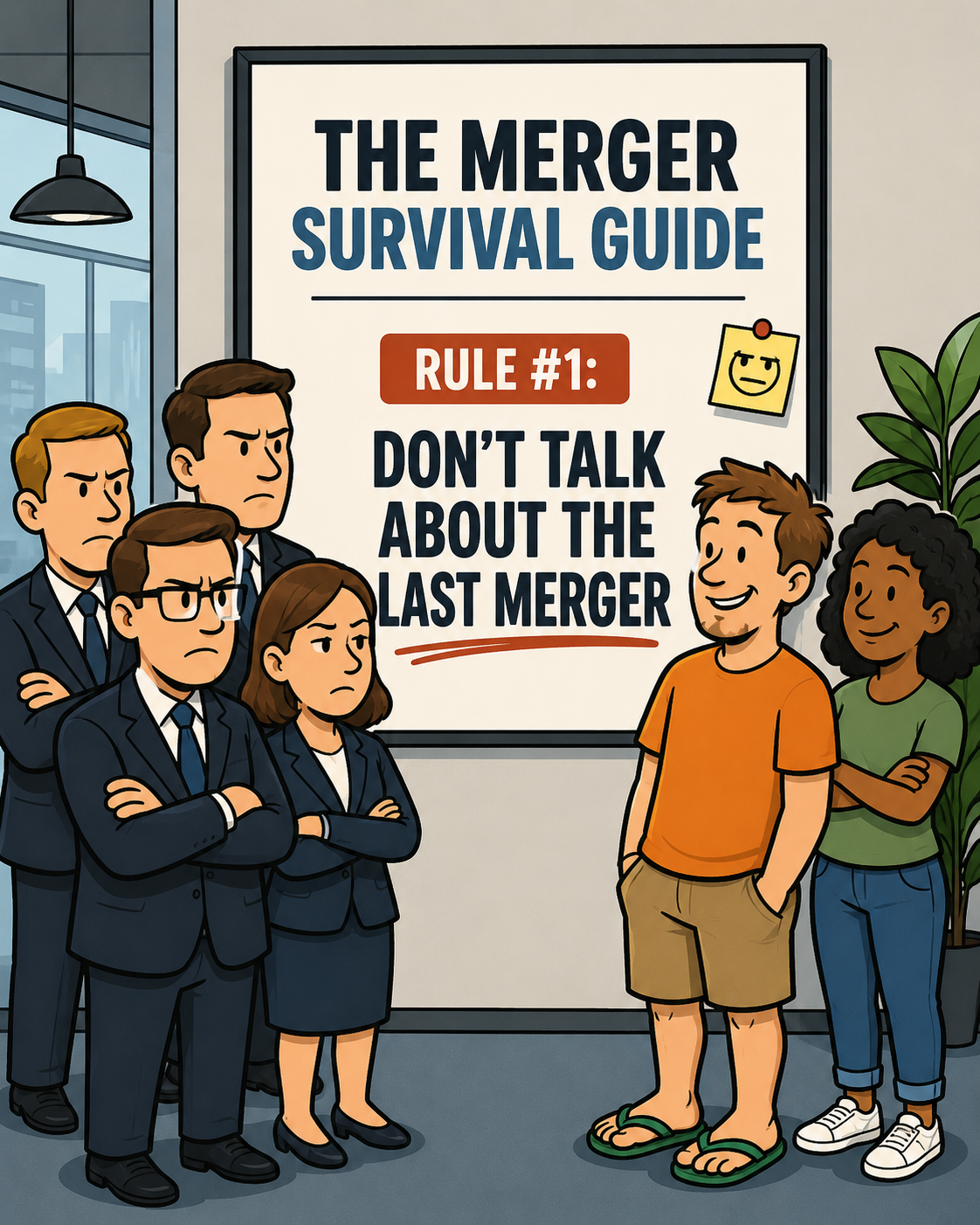



Mergers and acquisitions often fail to fully integrate organizations because they focus heavily on structures, systems, and financial synergies while underestimating cultural realities. The concept of “cultural debt” describes unresolved emotional, historical, and relational tensions that persist long after formal integration is complete. Identity conflicts, competing narratives, and unprocessed organizational history can silently undermine collaboration, trust, and long-term transformation efforts.
Organizations do not merge as spreadsheets, but as lived histories shaped by experiences, loyalties, and institutional memory. Cultural hangovers frequently remain invisible in KPIs, governance frameworks, and integration roadmaps — despite having significant operational impact. Sustainable integration therefore requires more than structural alignment: it depends on narrative alignment, symbolic integration work, and the creation of shared meaning across both organizations.
Ultimately, successful M&A integration is not only about combining assets, but about acknowledging and integrating the stories that shaped both organizations before the merger.
M&A does not just combine balance sheets. It collides unfinished histories.
The Myth of the Clean Slate
Executives often treat mergers as if they were administrative events: align assets, consolidate systems, harmonize processes, announce a new operating model — and assume the organization will eventually follow.
But organizations do not merge as spreadsheets. They merge as histories.
Every company entering an integration carries scars from past crises, pride in former achievements, unspoken hierarchies, narratives about “how we do things,” and emotional attachments to identity, status, and belonging.
When leaders treat cultures as interchangeable modules rather than lived experiences, they create a structural illusion: the deal is closed, but the integration has barely begun.
This is where the cultural hangover begins — the lingering presence of a past that refuses to disappear simply because a new logo has been printed.
What Exactly Is a Cultural Hangover?
A cultural hangover is the residual emotional, cognitive, and relational baggage that persists after two organizations formally become one. It is a headache caused not by alcohol, but by unresolved stories.
It usually emerges when three forces collide.
1. Abrupt identity shock
A merger destabilizes how employees understand who they are, what they stand for, where they belong, and how they contribute.
Identity disruption is not a side effect of M&A. It is one of its core emotional consequences.
2. Unprocessed collective history
If teams never talk about past leadership failures, old hierarchies, power struggles, broken promises, or why the merger actually happened, they fill the silence with speculation, nostalgia, and blame.
3. Competing narratives that outlive the deal
Comments such as “We bought them, not the other way around,” “They don’t understand our way of working,” or “Since the merger, nothing makes sense anymore” become underground scripts that steer behavior far more than integration playbooks.
Cultural Debt: The Invisible Liability
Technical debt in software accumulates when shortcuts postpone necessary refactoring. Cultural debt works in a similar way: organizations postpone the difficult emotional and narrative work of integration, hoping that structure alone will compensate.
But cultural debt accrues interest.
It shows up as duplicated informal hierarchies, passive-aggressive collaboration, identity-driven siloing, mistrust of leadership promises, shadow loyalty to previous leaders, retention issues in high-identity teams, and the systematic over-interpretation of harmless decisions.
Integration teams may report operational problems. But underneath, many of those problems are historical.
Cultural debt is what happens when organizations move forward structurally while remaining emotionally unresolved.
Case Study – The Merger That Finished Structurally but Never Emotionally
A multinational industrial company completed a major acquisition intended to create a “globally integrated operating model.” On paper, the merger appeared successful within 18 months:
- ERP systems were consolidated
- reporting structures were harmonized
- departments were reorganized
- and synergy targets were officially achieved
Executive communication described the integration as “largely completed.”
Internally, however, employees continued referring to themselves as “legacy North” and “legacy South” — years after the merger had formally ended.
Meetings revealed subtle but persistent fault lines:
- teams questioned decisions based on which side proposed them
- employees maintained informal loyalty networks from the pre-merger organization
- promotions were interpreted symbolically as victories or defeats for one former company
- and collaboration conflicts were routinely framed as “cultural incompatibility”
The official organization chart had changed. The emotional organization chart had not.
Leadership initially treated the tensions as communication problems. But internal interviews later revealed a deeper issue: many employees from the acquired company felt their identity had been erased rather than integrated.
Longstanding rituals disappeared. Informal status structures collapsed. Former managers lost symbolic influence even when they retained formal titles. Teams interpreted standardization efforts not as operational improvements, but as proof that one culture had “won.”
Over time, the unresolved tension produced classic symptoms of cultural debt:
- passive resistance to transformation initiatives
- duplicated shadow processes
- persistent distrust toward leadership messaging
- and increased attrition among high-identity teams
The merger had succeeded financially.
But culturally, large parts of the organization were still negotiating a past that leadership assumed had already disappeared.
The lesson was uncomfortable: integration had focused on systems, structures, and reporting lines — while largely ignoring the emotional and symbolic dimension of organizational identity.
In practice, the company discovered that culture does not integrate automatically when legal entities do.
Why Cultural Hangovers Undermine Even the Best M&A Strategy
1. Misaligned sensemaking
People interpret integration steps through the lens of their past experience. Structure changes quickly. Meaning does not.
2. Loss of psychological safety
M&A creates uncertainty. Uncertainty triggers identity protection. Identity protection becomes cultural rigidity.
3. Competing myths
Each legacy culture brings its own heroes, villains, origin stories, and explanations of success. These narratives do not automatically merge. They collide.
4. Symbolic contradictions
Leaders may say “integration is about equality,” while promotions, budgets, titles, systems, and reporting lines tell a different story. People trust symbols more than slogans.
5. Overconfidence in synergy logic
Executives often assume culture will follow strategy. But culture follows meaning, not structure.
Anatomy of a Post-Merger Cultural Hangover
Cultural hangovers rarely appear as one obvious failure. They show up as patterns: nostalgic enclaves that constantly refer to “how we used to do it,” integration ghost stories about the other company, shadow org charts that preserve old loyalties, and identity flare-ups where conflicts appear to be about tools or processes but are really about who gets to define the new normal.
Over time, frustration, grief, skepticism, and disappointment do not disappear when ignored. They harden into culture.
Why Leaders Underestimate Cultural Hangovers
Leaders underestimate cultural hangovers because they do not appear in integration management dashboards, synergy roadmaps, governance decks, financial models, or KPI reports.
Culture appears soft until it becomes the hardest constraint.
Executives are quick to invest in structures. But they often under-invest in meaning-making, narrative alignment, identity transition, emotional processing, and symbolic integration work because these tasks feel intangible and slow.
Ironically, they are often the real drivers of long-term M&A success.
How to Work With Cultural Debt Instead of Ignoring It
1. Start with narrative due diligence
Ask teams from both sides:
- What stories define your identity?
- What was emotionally significant in your recent history?
- What cultural ghosts might we encounter?
This reveals hidden constraints before they erupt.
2. Create shared meaning, not just shared structure
Integration is less about org charts and more about agreeing on why the merger happened, what future identity the combined organization will have, and which values are genuinely non-negotiable.
If people do not know the story, they invent one.
3. Acknowledge loss
Every merger is also a loss event. Teams may need to process the loss of identity, autonomy, familiar status, or even their “golden age.”
Unaddressed grief becomes passive resistance.
4. Build symbolic bridges
Do something that visibly contradicts the tribal narrative.
- Promote someone from the “other side.”
- Elevate a symbolic joint win early.
- Retire a toxic legacy ritual.
- Create a shared new ritual.
Symbols often move faster than structures.
5. Design integration as an emotional journey
Integrations fail when they are treated only as engineering projects rather than cultural transitions.
Leaders should intentionally design reflection forums, memory-sharing sessions, identity workshops, and meaning-making rituals.
This is not “soft stuff.” It is unblocking the actual bottleneck.
Conclusion: The Future Cannot Be Built on an Unresolved Past
The cultural hangover of M&A is not a flaw. It is a signal. It tells leaders that people cannot fully embrace a new identity while still haunted by the old one.
When organizations ignore the past, the past does not disappear. It moves underground and continues shaping the future through distrust, misinterpretation, symbolic resistance, and unspoken loyalties.
But when leaders treat culture as history rather than wallpaper — as something to integrate, not overwrite — they can turn cultural debt into cultural capital.
Because the truth is simple:
M&A can combine assets in a quarter. But it can only combine cultures when it honors the stories that came before.
- Stahl, G. K., & Voigt, A. (2008). Do Cultural Differences Matter in Mergers and Acquisitions? A Tentative Model and Examination. Organization Science, 19(1), 160–176. URL: https://pubsonline.informs.org/doi/10.1287/orsc.1070.0270
- Sarala, R. M., Vaara, E., & Junni, P. (2019). Beyond Merger Syndrome and Cultural Differences: New Avenues for Research on the “Human Side” of Global Mergers and Acquisitions. Journal of World Business, 54(4), 307–321. URL: https://www.sciencedirect.com/science/article/pii/S1090951617303231
- Marks, M. L., & Mirvis, P. H. (2011). A Framework for the Human Resources Role in Managing Culture in Mergers and Acquisitions. Human Resource Management, 50(6), 859–877. URL: https://www.researchgate.net/publication/264456574_A_framework_for_the_human_resources_role_in_managing_culture_in_mergers_and_acquisitions
- Schein, E. H. (2010). Organizational Culture and Leadership. 4th Edition. Jossey-Bass. URL (PDF):
https://ia800805.us.archive.org/9/items/EdgarHScheinOrganizationalCultureAndLeadership/Edgar_H_Schein_Organizational_culture_and_leadership.pdf - Carroll, G. R., & Harrison, J. R. (2002). Come Together? The Organizational Dynamics of Post-Merger Cultural Integration. Simulation Modelling Practice and Theory, 10(5–7), 349–368. URL: https://www.sciencedirect.com/science/article/abs/pii/S1569190X02000904
- Brede, M., & Decker, C. (2025). Mind the Gap: The Effect of Cultural Distance on Mergers and Acquisitions. Review of Managerial Science. URL: https://link.springer.com/article/10.1007/s11846-024-00811-8
- Jha, J. K. (2016). Effect of Cultural Differences on Performance of Merger and Acquisition via Psychological Safety: A Framework. OPUS: HR Journal, 7(1). URL: https://www.researchgate.net/publication/290315444_Effect_of_Cultural_Differences_on_Performance_of_Merger_and_Acquisition_via_Psychological_Safety_A_Framework