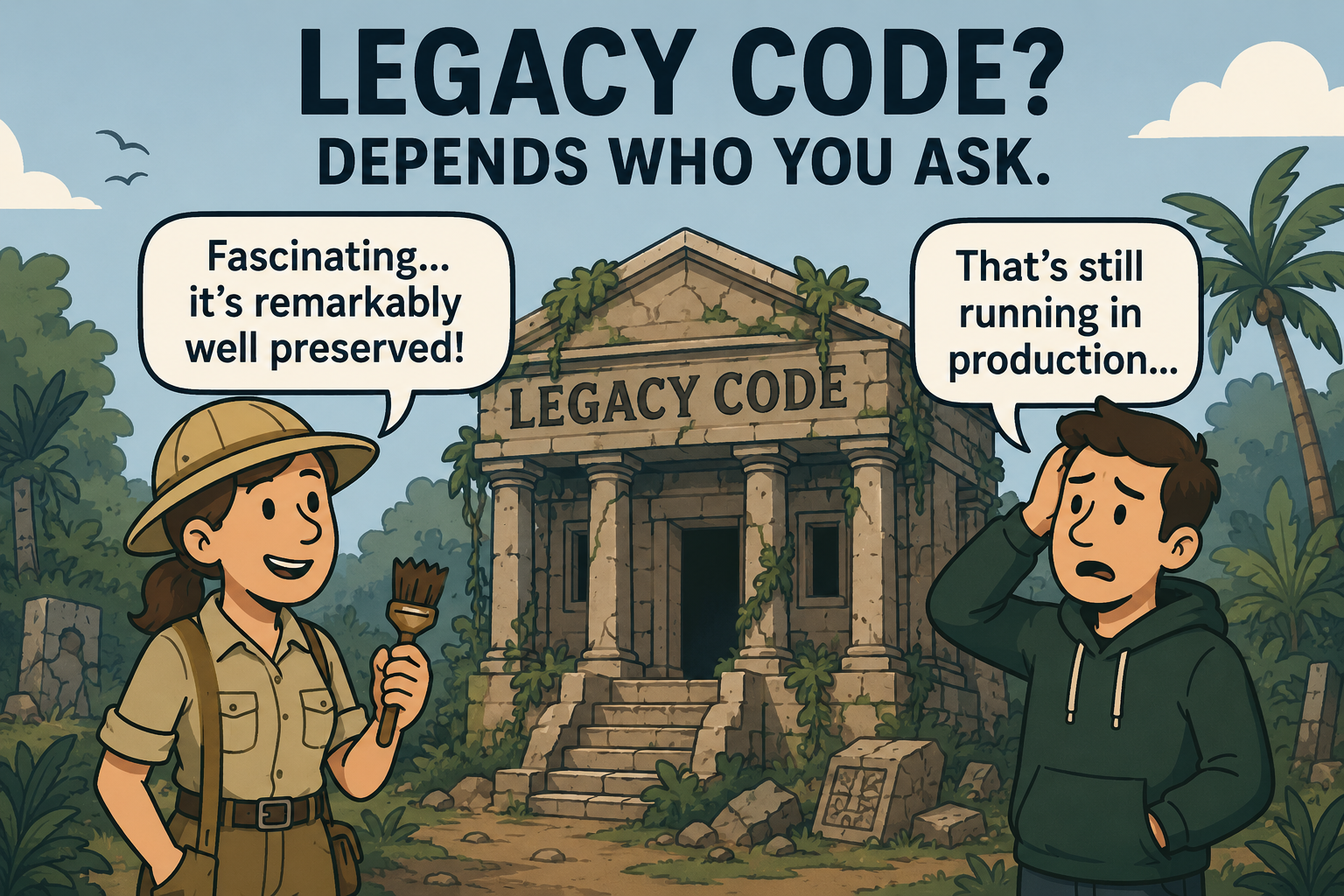



Modern organizations often depend on legacy systems that nobody fully understands — yet nobody dares to replace. This article explores enterprise IT as a form of digital archaeology: layers of software, processes, workarounds, and institutional memory accumulated over decades of mergers, audits, temporary fixes, and operational survival. It argues that legacy infrastructure is not merely outdated technology, but embedded organizational logic, political structure, and hidden governance. The piece examines why modernization projects so often fail, how complexity creates dependency and power, and why replacing legacy systems requires understanding the organization itself — not just rewriting code.
Some enterprise systems are not maintained because they are modern. They are maintained because nobody dares to find out what happens when they stop running.
Every large organization has systems that feel less like software and more like archaeological sites.
Layers of applications, databases, scripts, interfaces, manual workarounds, undocumented dependencies, and forgotten business rules sit on top of each other. New dashboards are built over old databases. APIs wrap legacy processes. Modern cloud platforms exchange data with systems designed for a different era.
From the outside, everything may look digital. Inside, the organization often runs on infrastructure nobody fully understands — and nobody really wants to touch.
Legacy systems survive not because they are always good, but because the cost of understanding them has become too high.
Legacy Is Not Just Old Software
The word “legacy” is often used as shorthand for outdated technology. But in enterprise environments, legacy software is rarely just old code.
It is usually a combination of technology, process, knowledge, risk, governance, and institutional memory.
A legacy system may contain:
- old business rules that were never formally documented
- integrations that only work because nobody has changed them
- exception logic created for customers, regulators, mergers, or emergencies
- manual steps that everyone treats as “the process”
- knowledge held by a few people who became part of the architecture
That is why replacing legacy systems is rarely just a technical project. It is an excavation.
The Archaeology of Enterprise IT
Enterprise IT rarely evolves in clean architectural stages. It grows through deadlines, compromises, acquisitions, budget cycles, compliance demands, vendor decisions, and temporary fixes that become permanent.
Over time, each decision leaves a layer.
- A reporting tool is added because the core system cannot answer a business question.
- A spreadsheet becomes a control mechanism because no workflow exists.
- A manual approval remains because nobody trusts the automated one.
- A middleware layer is introduced to avoid touching the legacy core.
- A new interface is built to make an old process look modern.
This is how organizations create digital sediment. Not by design, but by accumulation.
Eventually, enterprise architecture becomes less a blueprint and more a historical record of fear, urgency, politics, audits, mergers, vendor lock-in, and survival.
Case 1 – COBOL Banking Systems and Institutional Dependency
Many financial institutions still depend on COBOL-based core banking systems originally developed decades ago. These systems process transactions, calculate interest, manage account states, and coordinate regulatory reporting at enormous scale.
From a technical perspective, such systems are often considered outdated. But replacing them is not simply a migration problem. Over decades, the software accumulated undocumented business rules, regulatory adaptations, exception paths, and operational safeguards.
In many cases, nobody fully understands which downstream processes depend on specific behaviors of the legacy system. Small changes can unexpectedly affect reconciliation workflows, overnight batch processing, fraud detection, customer reporting, or compliance obligations.
The result is a paradox: the system may be technologically obsolete, yet operationally indispensable. Institutions continue running infrastructure they no longer fully understand because the risk of replacement exceeds the visible cost of maintenance.
In this sense, the COBOL platform is no longer merely software. It has become institutional memory encoded in executable form.
Case 2 – Java Systems Frozen in Time
Some enterprise Java applications become effectively trapped on outdated platform versions because their dependency landscape evolved faster than the organization’s ability to modernize it.
Over years, applications accumulate tightly coupled frameworks, deprecated libraries, proprietary vendor integrations, custom authentication modules, and handwritten patches that were never designed for long-term maintainability.
A system originally built for Java 6 or Java 8 may technically still operate, but upgrading it to newer Java versions can trigger cascading incompatibilities throughout the stack. Libraries become unsupported, APIs disappear, bytecode assumptions fail, application servers behave differently, and undocumented workarounds suddenly break.
Organizations often respond by freezing the environment entirely. Operating systems remain outdated because the JVM cannot change. Security updates become difficult because middleware compatibility is uncertain. Virtualization layers are introduced merely to preserve historical runtime assumptions.
Eventually, the application no longer evolves according to architectural intent. It survives through environmental containment.
Case 3 – University Information Systems and Layered Modernization
Many university information systems evolved over decades through incremental modernization rather than coherent architectural redesign.
In some environments, originally monolithic applications were partially migrated toward ORM frameworks such as Hibernate — but only in selected modules. Other parts of the system continued using older persistence mechanisms, direct SQL access, or manually managed database logic.
Later modernization initiatives introduced service-oriented architectures based on SOAP interfaces to integrate examination management, enrollment, identity management, finance, reporting, and administrative systems.
As architectural trends shifted toward REST-based APIs, organizations often avoided replacing the SOAP infrastructure directly. Instead, REST layers were added externally as compatibility façades while the underlying SOAP services remained operational internally.
The result is a stratified architecture where multiple technological eras coexist simultaneously:
- legacy persistence logic
- partial ORM migration
- SOAP-based integration layers
- REST compatibility adapters
- manual administrative workarounds
From the outside, the platform appears modernized. Internally, however, each architectural layer preserves assumptions from the period in which it was introduced.
The system no longer reflects a single design philosophy. It reflects the historical sequence of institutional constraints, budget cycles, modernization projects, and operational compromises that accumulated over time.
Why Nobody Touches the Core
Legacy systems often become untouchable because they sit at the center of too many dependencies.
They may connect finance, HR, customer data, logistics, compliance, reporting, identity management, contracts, access rights, and regulatory processes. Nobody can say with certainty what will break if one component changes.
The risk is not only downtime.
The deeper risk is that the organization discovers it does not actually understand how it operates.
That is why legacy replacement projects often fail before they begin. Not because the new technology is impossible, but because the old reality is unknown.
Most legacy systems are not maintained by documentation. They are maintained by collective superstition.
The Hidden Business Logic
Legacy systems often contain business logic that no policy document, process map, or governance framework fully reflects.
A field may be mandatory because of a regulation that no longer exists. A workflow may require approval from a department that has been reorganized three times. A data export may run every night because one downstream report still depends on it. A validation rule may block cases that are legally valid but technically inconvenient.
Over time, the system stops merely supporting the organization.
It starts defining what the organization believes to be possible.
This is where legacy software becomes more than technical debt. It becomes operational authority.
Legacy as Organizational Debt
Technical debt is often discussed as a software problem. But in large organizations, legacy systems usually represent organizational debt.
They preserve old decisions:
- old approval structures
- old risk assumptions
- old data models
- old power relationships
- old ideas about customers, employees, compliance, and control
This is why modernization often becomes uncomfortable. Replacing legacy software means questioning the organizational logic embedded inside it.
And many organizations would rather modernize the interface than confront the operating model.
The Politics of Legacy Infrastructure
Legacy systems also survive because complexity creates protection.
If only a few people understand a system, those people become indispensable. If only one department controls a workflow, that department keeps power. If nobody understands the full dependency map, nobody can easily challenge the status quo.
In this sense, legacy is not only a technical condition. It can become a political arrangement.
Every legacy system has stakeholders who benefit from its complexity — even if nobody says so openly.
That does not mean legacy owners act in bad faith. Often, they are the people keeping the organization alive. But it does mean that modernization is never neutral. It changes responsibilities, visibility, accountability, and control.
The Modernization Trap
Many modernization programs fail because they treat legacy as an engineering problem alone.
The organization replaces the front end, introduces APIs, migrates selected workloads to the cloud, or adds a new workflow platform. But underneath, the same assumptions remain:
- the same undocumented exceptions
- the same approval bottlenecks
- the same fragmented ownership
- the same spreadsheet-based controls
- the same fear of touching the core
The result is not transformation. It is legacy with a better user interface.
Modernization becomes cosmetic when architecture changes but governance does not.
Why Rewrites Are So Dangerous
The obvious answer to legacy software is often: rebuild it.
But large-scale rewrites are dangerous because they assume the organization knows what the system actually does. In practice, much of the critical logic exists only in edge cases, exceptions, habits, and accumulated operational experience.
The old system may be ugly, slow, expensive, and fragile. But it also encodes years of survival.
A clean rewrite can accidentally remove:
- exceptions that keep important customers served
- compliance logic nobody documented
- workarounds that prevent operational failure
- informal safeguards created by experienced employees
That is why legacy modernization must begin with understanding, not replacement.
Toward Responsible Modernization
Responsible modernization starts by treating legacy systems as evidence.
They reveal how the organization actually works — not how its process documentation claims it works.
Before replacing legacy infrastructure, organizations need to map:
- which processes depend on it
- which decisions are encoded in it
- which people hold undocumented knowledge
- which rules are technical, legal, historical, or merely habitual
- which dependencies would fail if the system changed
Modernization is not only about replacing old systems with new ones. It is about making hidden dependencies visible, turning implicit knowledge into shared understanding, and deciding consciously which parts of the past still deserve to shape the future.
AI and the Future of Legacy Understanding
Artificial intelligence may change legacy modernization — but perhaps not in the way many organizations expect.
Much of the current discussion focuses on AI-generated code, automated migration, or accelerated software replacement. But the deeper problem of legacy infrastructure is often not code generation. It is organizational understanding.
Large language models and AI-assisted analysis tools may become valuable not because they can instantly rewrite enterprise systems, but because they can help reconstruct the hidden logic embedded inside them.
Legacy environments contain enormous amounts of undocumented knowledge:
- dependencies hidden across systems
- business rules encoded in procedural logic
- historical exception handling
- implicit operational assumptions
- interfaces nobody fully mapped
AI systems may help organizations analyze source code, correlate logs, trace dependencies, summarize workflows, identify dead interfaces, and surface architectural patterns that were previously too complex to understand holistically.
But this also reveals the real limitation of modernization.
The challenge is rarely just translating old code into new syntax. The challenge is understanding which parts of the organization have silently become dependent on behaviors nobody formally designed.
AI may accelerate technical migration. It cannot automatically resolve institutional ambiguity, political dependencies, fragmented ownership, or decades of accumulated organizational compromise.
In that sense, artificial intelligence may become less a replacement engine and more an archaeological instrument — helping organizations finally understand the systems they have been operating for years without fully seeing.
Conclusion
Legacy software is not simply outdated technology. It is the accumulated memory of an organization — its compromises, fears, shortcuts, exceptions, mergers, audits, and survival strategies.
Some of it is valuable. Some of it is dangerous. Most of it is poorly understood.
The real challenge is not to destroy legacy blindly. It is to stop treating it as untouchable.
Because the systems nobody dares to touch often become the systems that quietly define what the organization can and cannot become.
At some point, legacy software stops being technology. It becomes institutional memory — and sometimes, institutional fear.
- Bisbal, J., Lawless, D., Wu, B., & Grimson, J. (1999). Legacy Information Systems: Issues and Directions. IEEE Software, 16(5), 103–111. URL: https://ieeexplore.ieee.org/document/795108
- Caballar, R. D., & Stryker, C. (2026). What is COBOL modernization? IBM Think. URL: https://www.ibm.com/think/topics/cobol-modernization
- IBM Think Editorial Staff. (n.d.). What is a Mainframe? IBM Think. URL: https://www.ibm.com/think/topics/mainframe
- Wright, A., Singh, D., & Aujla, D. (2024). Breaking the Cycle of Legacy Modernization: What Should Banks Do Differently Tomorrow? Thoughtworks. URL: https://www.thoughtworks.com/en-de/insights/articles/breaking-the-cycle-of-legacy-modernization
- Cartwright, I., Horn, R., & Lewis, J. (2024). Patterns of Legacy Displacement: Effective Modernization of Legacy Software Systems. Martin Fowler. URL: https://martinfowler.com/articles/patterns-legacy-displacement/
- Fowler, M. (2024). Strangler Fig Application. Martin Fowler. URL: https://martinfowler.com/bliki/StranglerFigApplication.html
- Williams, R. (2026). Reduce and Manage Technical Debt: Use a Structured Method to Manage Infrastructure Technical Debt. Gartner. URL: https://www.gartner.com/en/infrastructure-and-it-operations-leaders/topics/technical-debt
- Evans, E. (2003). Domain-Driven Design: Tackling Complexity in the Heart of Software. Pearson International. ISBN: 978-0-321-12521-7. URL: https://www.pearson.de/domain-driven-design-tackling-complexity-in-the-heart-of-software-9780321125217
- Newman, S. (2019). Monolith to Microservices: Evolutionary Patterns to Transform Your Monolith. O’Reilly Media. URL: https://samnewman.io/books/monolith-to-microservices/
- Agrawal, S. (2025). What Is Technical Debt and Why Does It Matter to Every Enterprise? TechRadar Pro. URL: https://www.techradar.com/pro/what-is-technical-debt-and-why-does-it-matter-to-every-enterprise
- Scott, J. C. (1999). Seeing Like a State: How Certain Schemes to Improve the Human Condition Have Failed. Yale University Press. URL: https://yalebooks.yale.edu/book/9780300078152/seeing-like-a-state/
- Graeber, D. (2016). The Utopia of Rules: On Technology, Stupidity, and the Secret Joys of Bureaucracy. Melville House. URL: https://mhpbooks.com/books/the-utopia-of-rules/