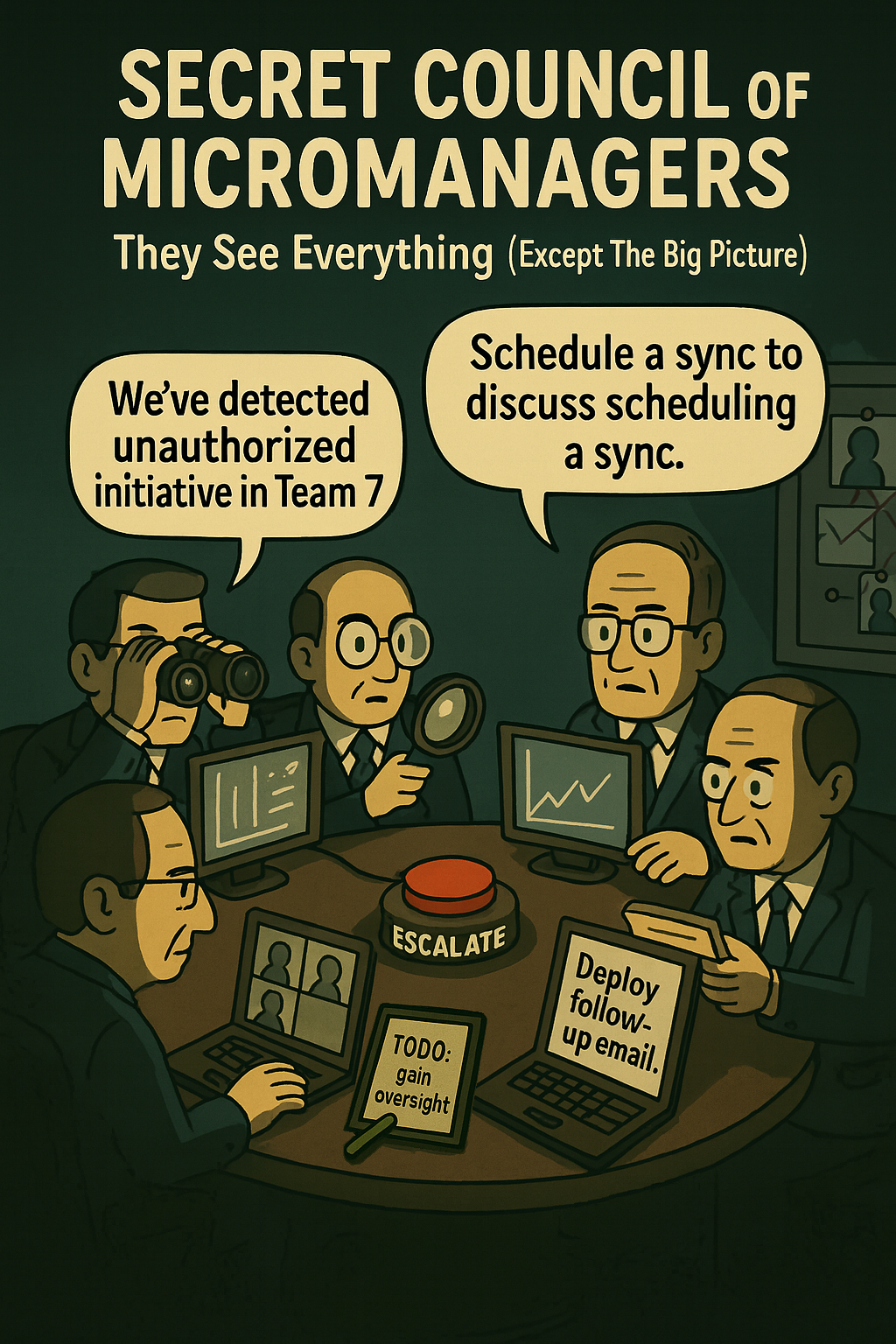



Micromanagement is rarely about controlling others — it’s a systemic response to uncertainty. When organizations reward visibility over value and compliance over competence, leaders default to oversight as a coping mechanism. Behind most micromanagers lies not dominance, but organizationally induced insecurity: fear of becoming irrelevant, loss of expert identity, and anxiety amplified by unclear strategic direction.
This article reframes micromanagement as an organizational design failure rather than an individual flaw. It explores why control feels safe, how oversight becomes self-reinforcing, and why psychological safety erodes quietly in its wake. Drawing on research and cross-industry evidence, it highlights where the science is strong, where it falls short, and what leaders must redesign if they want trust, autonomy, and meaningful impact to scale.
Micromanagement rarely stems from personality alone — it often emerges when systems and culture reward control over trust.
From daily stand-ups to escalation emails, organizations have built entire ecosystems to monitor, correct, and steer employee behavior. But in the pursuit of "oversight", they've often lost sight of the bigger picture. Micromanagement is not about managing better — it's about masking deeper insecurities: lack of trust, fear of losing relevance, or an outdated belief that visibility equals value.
The Human Behind the Micromanager
Micromanagement is often framed as a behavioral defect, but underneath it lies something deeply human. When leaders feel uncertain, disconnected from expertise, or pressured to perform, they fall back on the one thing they believe they can control: other people’s actions.
Psychology research highlights three recurring drivers:
- Fear of irrelevance: As teams become more autonomous, some leaders double down on proving their importance through oversight.
- Identity insecurity: Managers who built their careers on being subject-matter experts struggle to let go of tactical decisions.
- Anxiety amplification: Under high pressure, the brain defaults to familiar patterns — including excessive checking, directing, and escalating.
In other words: micromanagement is rarely about dominance. More often, it’s about fear. And fear scales astonishingly well in organizations.
The Illusion of Oversight
Micromanagers believe that by monitoring every detail, they can ensure outcomes. But scrutiny ≠ alignment. Excessive oversight creates a feedback loop where managers supervise processes they don’t understand, focusing on superficial metrics instead of meaningful impact. Every initiative becomes a “risk,” every deviation a “compliance issue.” Control replaces collaboration.
Anatomy of Micromanagement
- Surveillance without context: Dashboards, reports, and sync meetings create a false sense of situational awareness.
- Escalation reflex: Problems are not solved — they are escalated up the chain, diffusing ownership.
- Initiative suppression: Teams learn that proactive behavior often triggers unnecessary oversight.
- Process over purpose: Activities are monitored for compliance, not for contribution to strategic goals.
Why Micromanagement Feels Safe
Micromanagement offers an illusion of control in environments of uncertainty. When leadership lacks strategic clarity, they default to tactical visibility. It’s easier to review timesheets than to evaluate team morale. Easier to track email response times than to ask if those emails matter. It becomes a comfort zone of activity-driven leadership.
But this control reflex has a hidden cost: it silently erodes psychological safety. As Amy Edmondson and co-authors repeatedly point out, psychological safety — the belief that one can speak up, take risks, and admit mistakes without fear of reprisal — is essential for team learning and innovation. Micromanagement systematically undermines this environment, leading teams to opt for silence over initiative.
A Thread to Validity: What the Evidence Says — and Where It Fails
Despite its prevalence, micromanagement is surprisingly under-researched. We know from Hamilton (2025) that:
- 59% of employees report having worked under a micromanager at some point.
- Among them, 68% report lower morale, and 55% lower productivity.
- Industry studies (healthcare, manufacturing, IT) show measurable links between micromanagement, job stress, burnout, and reduced commitment.
What we don’t have is equally important:
- no large-scale, cross-industry causal studies,
- no consistent definitions or validated measurement models,
- no longitudinal research connecting structure, personality, and outcomes.
The result: we know micromanagement is common and harmful — but we lack rigorous models explaining how system design, culture, and managerial psychology interact. This is exactly where organizations over-generalize and blame individuals instead of structures.
Breaking the Control Culture
- What outcomes do we truly need to influence?
- Where does oversight create friction instead of clarity?
- How can we shift from monitoring processes to enabling autonomy?
- What would happen if we stopped escalating and started trusting?
“Micromanagement is not usually a flaw in leadership — it's a flaw in organizational design.”
The Case for Intentional Oversight
Oversight isn't the enemy. But it must be intentional, selective, and anchored in trust. High-trust teams don’t need surveillance; they need clarity of purpose and access to support when needed. The goal is to create a culture where visibility is a byproduct of collaboration, not a substitute for it.
How to Rethink Control Structures
- Audit your escalation loops: Identify where information flow is a bottleneck, not a support system.
- Rebuild trust protocols: Shift from permission-based to principle-based decision-making. Leaders should step in only when ready and with a clear purpose of helping — not directing.
- Design for autonomy: Equip teams to self-manage within strategic boundaries.
- Measure outcomes, not activity: KPIs should reflect impact, not micromanaged compliance.
Conclusion
Micromanagement is a symptom — not a leadership style. It's what happens when systems prioritize visibility over value, compliance over competence. To move beyond it, organizations must challenge their own control reflex and design structures that reward trust, initiative, and meaningful outcomes.
In the end, control culture doesn’t scale. But trust-driven teams do. The future belongs to organizations that know when to zoom out.
Visibility is not leadership. Trust is.
- Gallo, A. (2023). What Is Psychological Safety? Harvard Business Review. URL: https://hbr.org/2023/02/what-is-psychological-safety
- Edmondson, A. C.; & Kerrissey, M. (2025). What People Get Wrong About Psychological Safety. Harvard Business Review. URL: https://hbr.org/2025/05/what-people-get-wrong-about-psychological-safety
- Hamilton, D. (2025). Micromanagement Is Killing Innovation: The Leadership Shift Teams Need. Forbes. URL: https://www.forbes.com/sites/dianehamilton/2025/02/03/micromanagement-is-killing-innovation-the-leadership-shift-teams-need/
- Shamspour, H. R.; Kamali, M.; Narouei, B.; Okocha, B.; & Dolatabadi, M. (2024). Impact of Micromanagement on Organizational Commitment Through Mediating Role of Job Stress, Moderating Effect of Hostile Attribution Bias. International Journal of Business and Management Sciences, 5(3), 56–77. URL: https://ijbmsjournal.com/index.php/jbmis/article/view/642
- Lee, J.; Ahn, S.; Henning, M. A.; van de Ridder, J. M. M.; & Rajput, V. (2023). Micromanagement in Clinical Supervision: A Scoping Review. BMC Medical Education, 23(1), 563. DOI: 10.1186/s12909-023-04543-3
- McCausland, T. (2023). Creating Psychological Safety in the Workplace. Research-Technology Management, 66(2), 56–58. DOI: 10.1080/08956308.2023.2164439